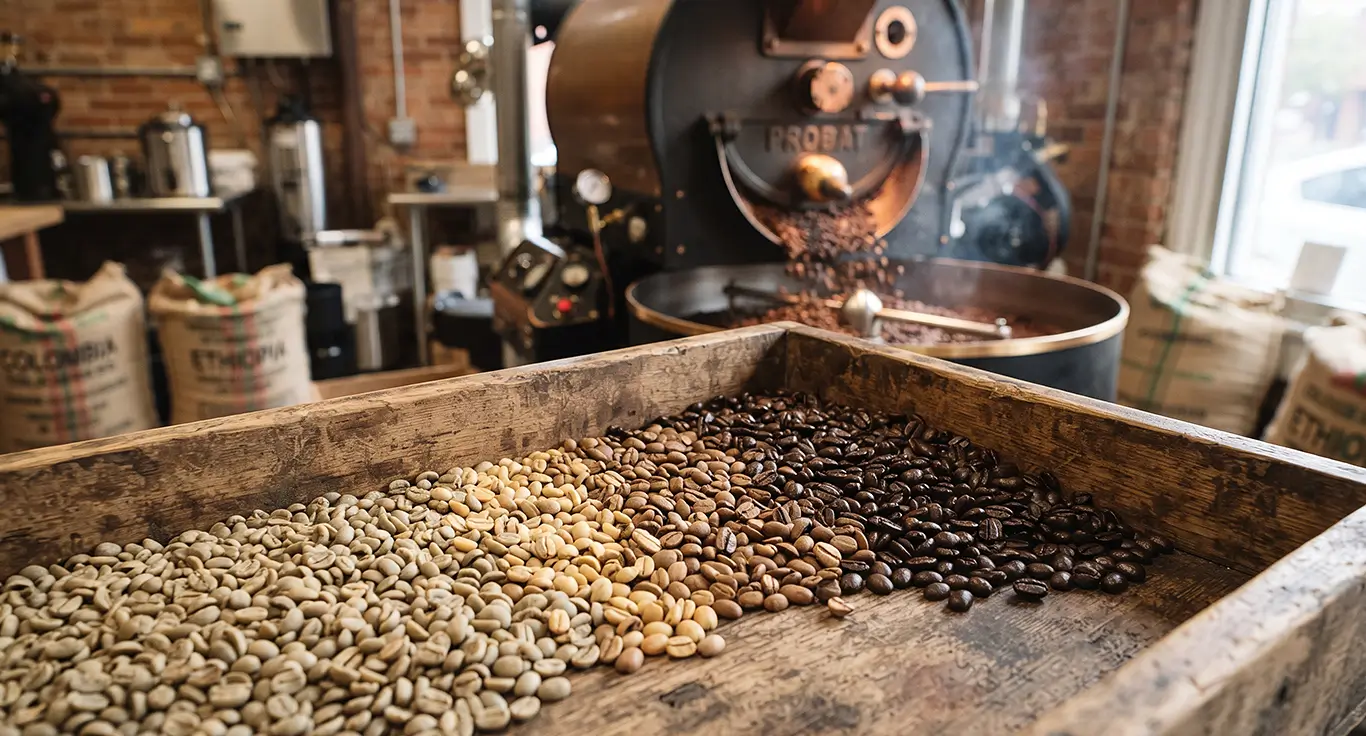
A coffee bean does not start its journey in the roasting machine. Long before heat is applied, processing at the origin has already changed the physical and chemical characteristics of the green coffee.
This is why a roast profile coffee roaster uses for one origin or processing method may not work equally well for another.
The way coffee cherries are processed affects moisture, density, structure, fermentation characteristics, and the flavor potential of the green bean. Roasters need to understand these differences when deciding how to apply heat and manage the roast.
Understanding this connection helps explain why good coffee roasting is not simply about choosing a light, medium, or dark roast. It is about responding to the characteristics of the green coffee.
Why Initial Coffee Bean Processing Matters
Coffee processing begins after ripe coffee cherries are harvested. The fruit surrounding the coffee seed must be removed or dried in a controlled way before the beans become stable green coffee ready for storage, export, and roasting.
The most common approaches include washed, natural, and honey or semi-washed processing.
Each method creates different conditions around the coffee seed during drying and fermentation. As a result, beans from the same coffee-growing region can behave differently during roasting even when they come from similar varieties.
For buyers, exporters, and roasters, processing is therefore more than a production detail. It is part of the coffee’s identity and can influence how the finished product should be developed.
What Happens During Initial Coffee Bean Processing
Washed Processing
In washed processing, much of the coffee fruit is removed before the beans are dried. The coffee may also undergo controlled fermentation to help remove remaining mucilage.
Washed coffees are often associated with clean and defined flavor characteristics. Their flavor expression can make them attractive for applications where clarity and origin character are important.
From a roasting perspective, the roaster still needs to evaluate the actual green bean rather than assuming that every washed coffee will behave in exactly the same way.
Natural Processing
Natural processing involves drying the coffee cherry with much of the fruit still surrounding the seed. During drying, the interaction between the fruit, microorganisms, moisture, and seed contributes to the coffee’s eventual character.
Natural coffees can show pronounced fruit, sweetness, and fermentation-related characteristics.
Because the drying process and green bean condition can differ significantly from washed coffees, the roasting approach may also need adjustment. A profile designed for a clean washed coffee should not automatically be copied for a natural coffee.
Honey or Semi-Washed Processing
Honey processing removes some of the fruit while leaving a portion of mucilage on the bean during drying. The exact approach can vary considerably between producers.
This makes honey-processed coffee particularly interesting from a roasting perspective. The coffee can have characteristics between washed and natural styles, although the final cup profile depends heavily on the specific processing method and production conditions.
The important point is that the processing name provides useful context, but it does not replace evaluation of the actual green coffee.
How Processing Changes Green Coffee Characteristics
Initial processing can influence several characteristics that matter during roasting.
Moisture is particularly important because the green bean contains water that must be driven off as the roast progresses. Differences in moisture can influence how the bean responds to heat.
Density and structure also affect heat transfer. Denser beans may respond differently from less dense beans, requiring the roaster to pay attention to how quickly heat is introduced and retained.
Fermentation characteristics can influence the flavor compounds available in the coffee. This is especially relevant for naturally processed and experimentally fermented coffees.
These factors do not determine a roast profile by themselves. They are inputs that help the roaster understand how the coffee may respond inside the roaster.
Connecting Green Coffee Characteristics to Roast Profile
A roast profile coffee approach involves controlling variables such as temperature, heat application, airflow, and timing throughout the roast.
The objective is not simply to make the beans darker. The objective is to develop the desired characteristics while avoiding defects such as scorching, tipping, underdevelopment, or excessive roast character.
Initial processing becomes relevant because the green bean enters the roaster with its own physical and chemical characteristics.
Moisture and Heat Transfer
Green coffee contains moisture that affects how heat moves through the bean.
A roaster therefore needs to observe how quickly the coffee progresses through the early stage of roasting, how the bean responds to increasing heat, and whether the development is proceeding as expected.
Rather than relying only on a fixed temperature target, experienced roasters evaluate the behavior of the coffee during the roast.
Bean Density and Structure
Density can influence how efficiently heat penetrates the bean.
If the heat is applied too aggressively, the outside of the bean may develop faster than the interior. If the roast progresses too slowly, the coffee may lose desirable characteristics or develop an undesirable baked character.
This is why roast development should be based on the coffee itself rather than a universal time-and-temperature formula.
Fermentation and Flavor Potential
Processing can contribute to distinctive flavor characteristics before roasting even begins.
A roasting profile should therefore preserve and develop the intended characteristics rather than simply adding more roast intensity.
For example, a coffee selected for fruit-forward characteristics may require a different approach from a coffee intended to emphasize chocolate, caramel, or nutty notes.
How Roasting Approach Can Differ by Processing Method
It is tempting to say that washed coffee should always be roasted one way and natural coffee another way. In reality, the relationship is more nuanced.
Processing method is one variable among many.
Origin, variety, altitude, harvest maturity, moisture, density, drying conditions, storage, and green bean age can all influence roasting behavior.
Two natural coffees can therefore require different roast profiles.
The same applies to washed coffees.
The practical approach is to use processing information as a starting point, then validate the roast through sample roasting, sensory evaluation, and roast data.
Why There Is No Universal Roast Profile
A common mistake is treating a roast profile as a fixed recipe.
For example, a roaster might record a successful roast and attempt to reproduce exactly the same temperature curve for a different green coffee. The result may be inconsistent because the new coffee does not have the same physical characteristics.
A better approach is to treat the roast profile as a controlled process.
The roaster can establish a target, monitor the roast, and adjust heat and airflow based on the coffee’s response.
This is particularly important for coffee suppliers and F&B businesses that source beans from different origins or processing methods. Consistency requires understanding the raw material before attempting to standardize the finished product.
Practical Considerations When Developing a Roast Profile
Before developing a roast profile, collect as much relevant information about the green coffee as possible.
Useful information includes:
- Origin and producing region
- Coffee variety
- Processing method
- Harvest period
- Moisture condition
- Bean density or size, where available
- Drying method
- Storage conditions
- Intended brewing or F&B application
- Desired flavor direction
The first roast should then be treated as an evaluation rather than the final answer.
Record the roast data and compare it with sensory results. Look at aroma, acidity, sweetness, body, aftertaste, balance, and any undesirable characteristics.
This approach makes it easier to determine whether the roast profile is actually supporting the coffee.
What This Means for Coffee Buyers and F&B Businesses
For coffee buyers, processing information can provide an early indication of what to expect from a green coffee.
However, processing alone should not be used to judge quality.
For F&B businesses, the bigger consideration is whether the resulting roasted coffee fits the intended application.
Espresso, filter coffee, cold brew, milk-based beverages, and packaged coffee can have different requirements. A roast profile that works beautifully for one application may not produce the same result in another.
This is where communication between green coffee suppliers, roasters, and F&B businesses becomes important.
The better the information available about the green coffee, the easier it becomes to develop a suitable roasting strategy.
Initial coffee bean processing is therefore part of a much longer quality chain. Harvesting and processing shape the green bean, roasting develops its potential, and brewing ultimately determines what the consumer experiences in the cup.
The key takeaway is simple: a good roast profile starts with understanding the green coffee. Processing method provides an important piece of that information, but the actual characteristics of each lot should guide the final roasting decisions.