Choosing Product Packaging for coffee beans is not just about finding a bag that looks good on the shelf. The packaging has to protect the coffee after roasting, fit the quantity you sell, survive transportation, and make sense for how customers use the product.
A small coffee roaster selling 250-gram bags may need a very different packaging solution from a business supplying 1-kilogram bags to cafés or exporting coffee in larger quantities.
The right choice starts with the coffee itself and ends with how the product reaches the customer.
Why Product Packaging Matters for Coffee Beans
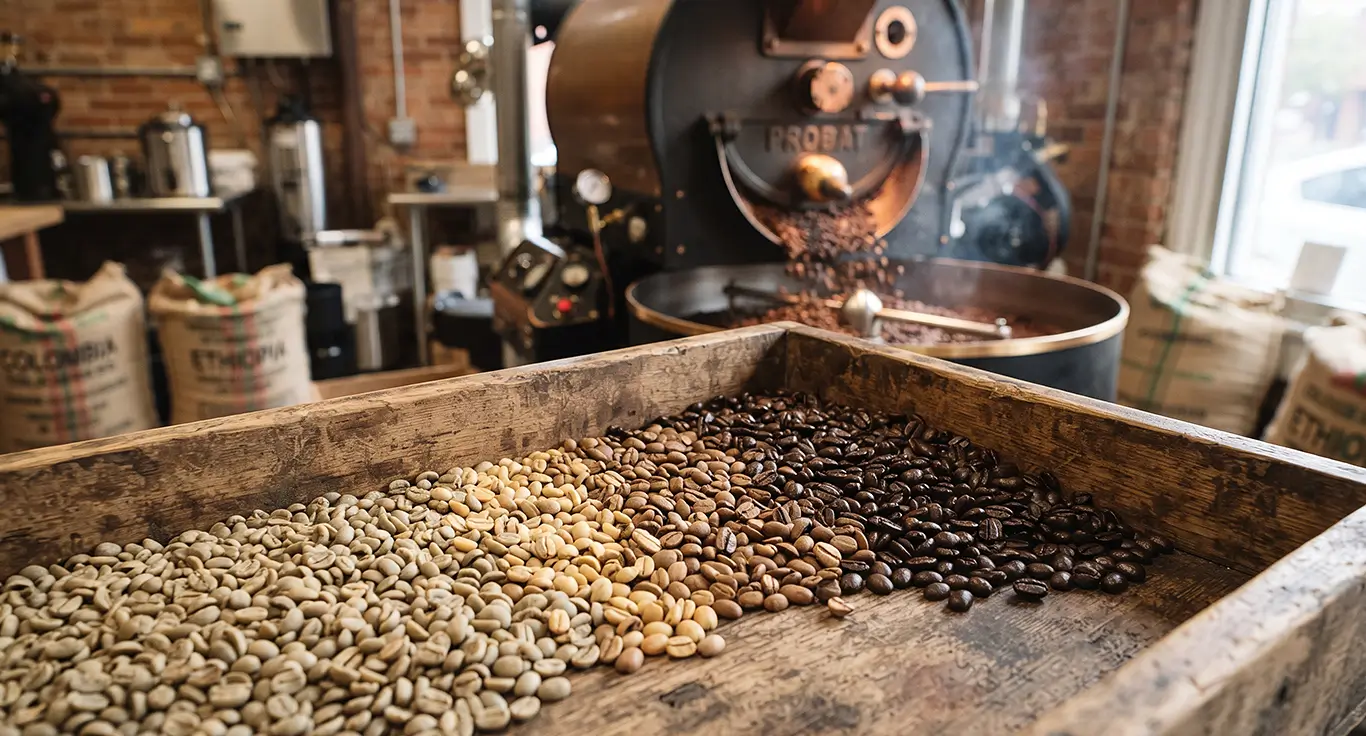
Roasted coffee beans are sensitive to several environmental factors, particularly oxygen, moisture, heat, and light. Poor packaging can allow the product to lose its desirable aroma and flavor more quickly.
Packaging also needs to manage carbon dioxide released by freshly roasted coffee. This is why coffee packaging often uses a one-way degassing valve, allowing gas to escape without allowing outside air to enter easily.
Protection, however, is only one part of the decision.
The packaging should also match your product quantity, storage conditions, distribution method, customer expectations, and brand positioning.
For example, a premium specialty coffee brand may prioritize a high-quality printed pouch with strong barrier properties, while a wholesale coffee supplier may put greater emphasis on larger sizes, durability, and transportation efficiency.
1. Start With the Protection Your Coffee Needs
Before choosing a material or design, determine what the packaging needs to protect the coffee from.
Oxygen and moisture protection
Oxygen can accelerate the deterioration of roasted coffee. Moisture can also affect product quality and is particularly important when coffee is stored or transported in humid environments.
For this reason, coffee packaging commonly uses barrier structures designed to limit oxygen and moisture transmission.
The exact barrier level you need depends on factors such as the expected shelf life, distribution conditions, packaging structure, and storage environment.
Light protection
Light exposure can also affect coffee quality over time. Opaque packaging provides more protection than transparent packaging when the product needs stronger light protection.
If customers need to see the beans, a transparent window can be considered, but it should be evaluated against the protection requirements of the product.
Degassing requirements
Freshly roasted coffee releases carbon dioxide after roasting. If the beans are packed too soon in a completely sealed package without a suitable way to manage the gas, internal pressure can build up.
A one-way degassing valve can help release carbon dioxide while reducing the entry of outside air.
Whether a valve is necessary depends on the product, roasting process, packaging method, and time between roasting and consumption.
2. Choose the Right Packaging Material
There is no single material that is automatically the best for every coffee business. The packaging structure should be selected according to the required barrier performance, format, cost, appearance, and distribution conditions.
Kraft paper packaging
Kraft paper can provide a natural, premium appearance that works well with specialty coffee and environmentally positioned brands.
However, paper alone is not necessarily enough to provide the barrier properties required for roasted coffee. Many coffee bags that look like paper are actually made from multiple layers, with paper used as part of the outer structure.
This distinction matters when comparing different packaging suppliers.
Plastic and multilayer films
Flexible plastic films are widely used in food packaging because they can be engineered with different barrier and sealing properties.
Multilayer structures can combine several functions, such as mechanical strength, printability, heat sealing, and protection against oxygen or moisture.
For coffee businesses, this can provide a practical balance between protection, appearance, and packaging performance.
Aluminum foil structures
Aluminum foil can provide a strong barrier against light, oxygen, and moisture when incorporated into a suitable packaging structure.
It can be useful when strong product protection is a priority, particularly for products requiring extended protection during storage or distribution.
The important point is to evaluate the complete packaging structure, rather than choosing a material based only on its name.
3. Select the Right Packaging Size
Packaging size should match how customers buy and consume the coffee.
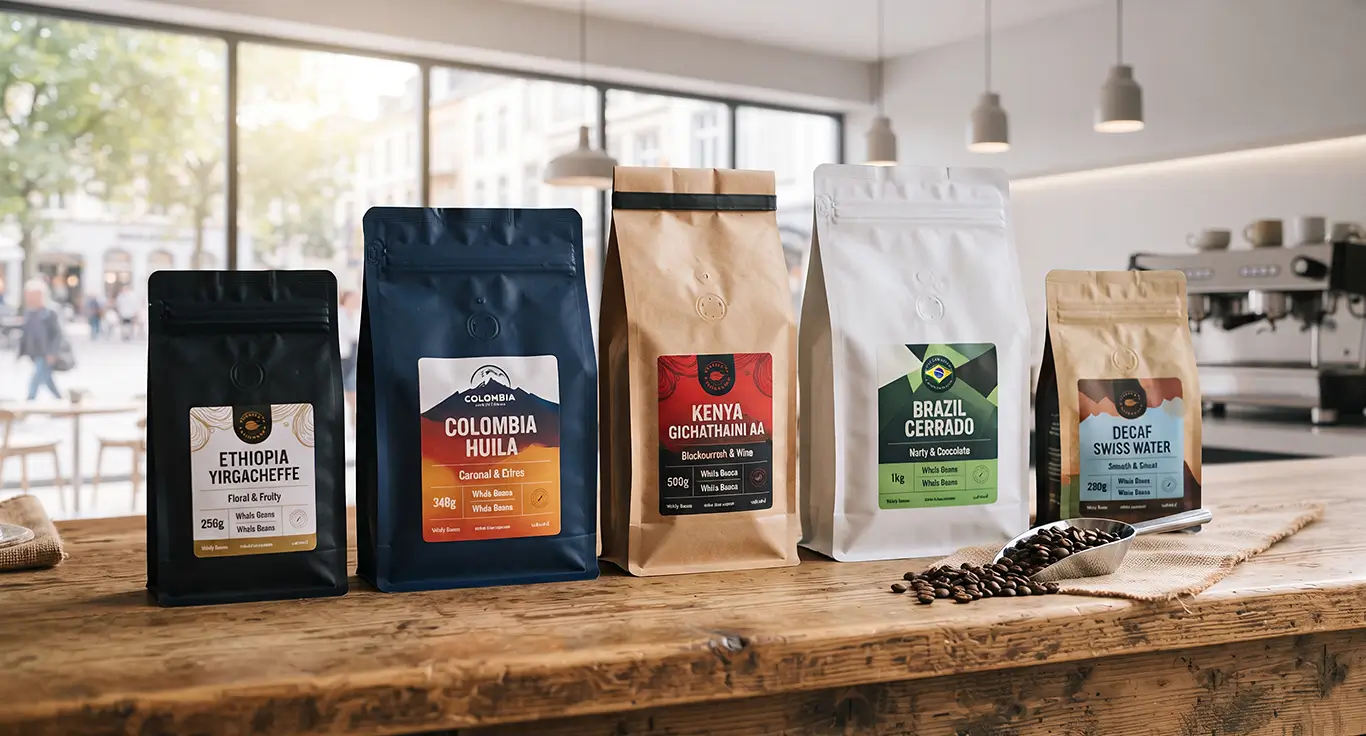
Common retail sizes include smaller packs such as 200–250 grams and larger formats such as 500 grams or 1 kilogram. The appropriate size depends on your target market and sales channel.
Consider these questions:
- How much coffee does the customer normally purchase?
- How quickly is the coffee expected to be consumed after opening?
- Is the product sold to households, cafés, offices, or distributors?
- Does the business need retail and wholesale sizes?
- How much packaging space is available during storage and shipping?
Smaller bags can be useful for retail customers who want fresh coffee without storing a large quantity after opening.
Larger bags can make more sense for cafés, restaurants, offices, and other customers with higher daily consumption.
Avoid selecting a bag simply because it has the correct weight printed on the specification sheet. Coffee beans vary in density, so the physical volume required for a particular weight can differ between products.
A packaging supplier may need the actual product or accurate dimensions to recommend the appropriate bag size.
4. Consider the Packaging Shape and Format
Coffee packaging is available in several formats, including stand-up pouches, flat-bottom bags, side-gusset bags, and other custom structures.
The shape affects both appearance and practical use.
Stand-up pouches can provide a modern retail appearance and are convenient for shelf presentation.
Flat-bottom bags can stand firmly and provide a larger printable surface, making them attractive for brands that want strong shelf visibility.
Gusseted bags can provide additional volume and are commonly used for larger coffee quantities.
Your choice should depend on the amount of coffee, shelf presentation, storage space, filling equipment, and transportation requirements.
A beautiful package that does not work well with your filling process can become an operational problem.
5. Match Packaging to Your Business Needs
The best Product Packaging depends heavily on the business model.
For specialty coffee brands
Focus on freshness protection, premium presentation, detailed product information, and customer experience.
A high-quality pouch with strong barrier properties, a reliable seal, and an appropriate degassing valve may be a practical option.
For cafés and wholesale buyers
Larger packaging formats may be more efficient. Durability and ease of storage become increasingly important because the product may be opened and used frequently.
Packaging should also be practical for stacking, transportation, and inventory management.
For online coffee businesses
E-commerce adds another consideration: transportation.
The package should be able to withstand handling during fulfillment and delivery without excessive deformation or seal damage.
A compact flexible format can also help reduce unnecessary shipping volume compared with rigid packaging.
For export markets
Export packaging requires more careful consideration of transportation time, environmental conditions, handling, labeling requirements, and destination-market regulations.
The packaging that works for a local delivery may not automatically be suitable for a longer international supply chain.
6. Don’t Forget Convenience and Branding
Protection keeps the coffee in good condition, but convenience can influence how customers experience the product.
Features worth considering include:
- Resealable zipper
- One-way degassing valve
- Easy-open notch
- Strong heat seal
- Appropriate pouch stiffness
- Clear product labeling
- Suitable printing area
Branding should support the product rather than compromise its function.
For example, a coffee package should make important information easy to find, such as roast level, origin, net weight, roast date, product name, and brewing recommendations where applicable.
If you are ordering custom packaging, confirm the printing method, color requirements, minimum order quantity, artwork specifications, and lead time before production.
Common Mistakes When Choosing Coffee Packaging
One common mistake is choosing packaging based only on appearance.
A bag may look premium but still be unsuitable if its barrier performance, seal quality, or size does not match the coffee.
Another mistake is focusing only on price. A cheaper package may become expensive if it creates product losses, poor shelf presentation, filling problems, or transportation damage.
It is also easy to select the wrong size because coffee bean density varies.
Finally, businesses sometimes order a large quantity before testing the packaging with the actual product and filling process. A sample or trial production can reveal problems before they become expensive.
A Simple Checklist Before Ordering Product Packaging
Before placing an order, check these points:
- Coffee type: What product are you packing?
- Product weight: What quantity will each package contain?
- Freshness requirements: How much protection is needed against oxygen, moisture, and light?
- Degassing: Does the package require a one-way valve?
- Material: Does the packaging structure provide the required protection?
- Format: Which pouch or bag shape works with your product and filling process?
- Closure: Is a zipper or other resealing feature useful?
- Distribution: Will the coffee be sold locally, online, wholesale, or exported?
- Branding: What information and visual elements need to appear on the package?
- Testing: Has the packaging been tested with the actual coffee and production process?
The goal is not to find the most complicated package. It is to find the package that provides the right balance of product protection, usability, appearance, operational efficiency, and cost.
For coffee businesses, that usually means starting with the product requirements first and choosing the packaging format second. Once those requirements are clear, it becomes much easier to compare materials, sizes, shapes, and custom features with a packaging supplier.