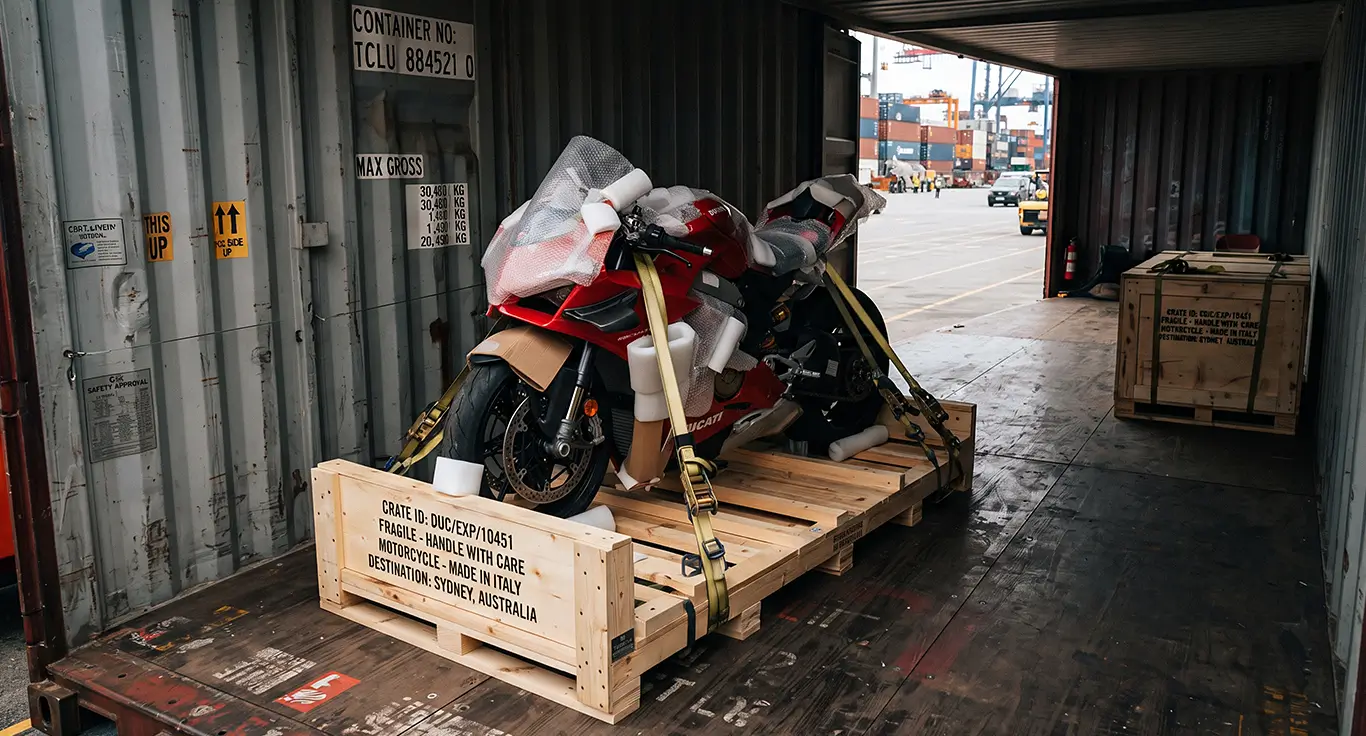
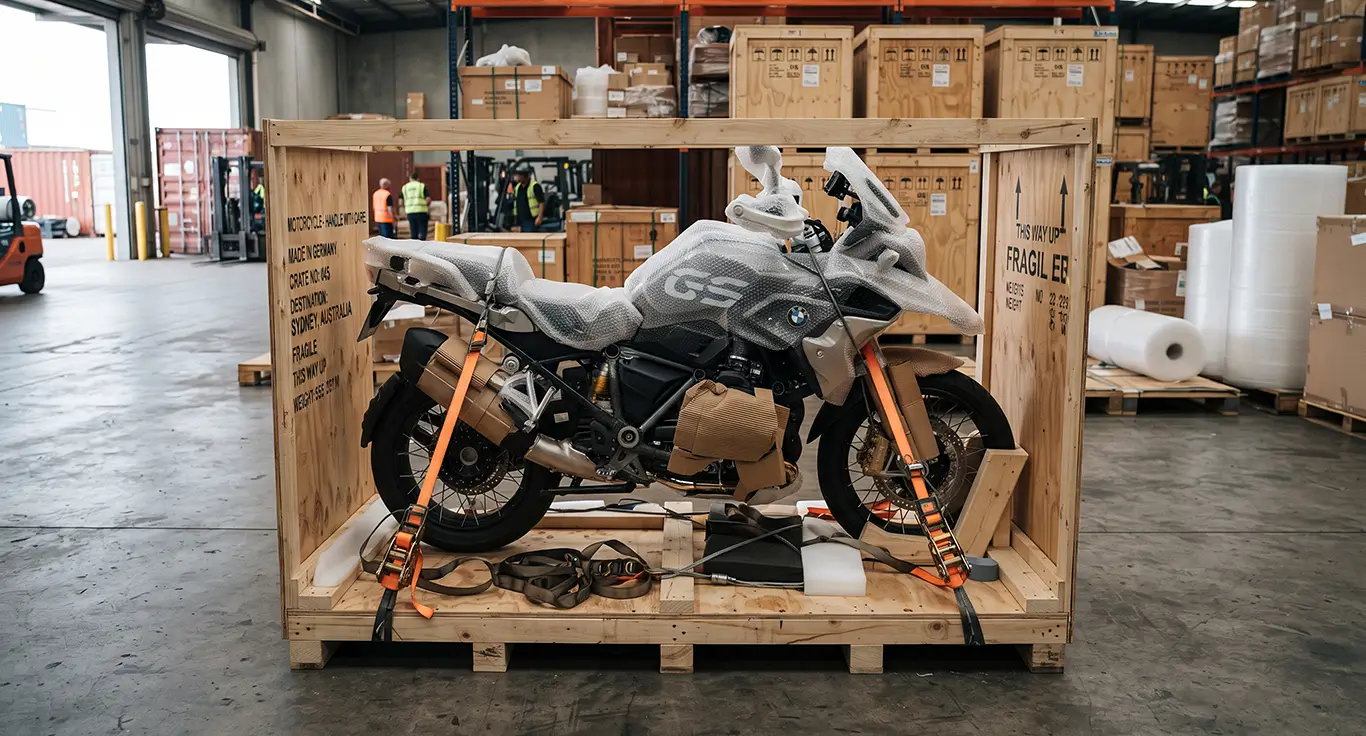
Ordering only one or two motorcycles for commercial display sounds simple. You do not need a large shipment, so using LCL motorcycle shipping may seem like the obvious way to save money.
LCL, or Less than Container Load, allows cargo from different shippers to share container space. On paper, this sounds ideal for a small motorcycle order.
But motorcycles are not always a good fit for LCL.
For small orders, the cost of packing, cargo handling, consolidation, documentation, and destination services can make the cost per motorcycle higher than expected. That is why LCL should be evaluated based on the complete shipping cost rather than simply the amount of container space used.
What Is LCL Motorcycle Shipping?
LCL motorcycle shipping means your motorcycles are shipped in a container together with cargo belonging to other customers.
Instead of paying for an entire container, you generally pay based on the space or shipment volume occupied by your cargo, along with applicable handling and service charges.
This can be useful when a buyer does not have enough motorcycles or other goods to fill a full container.
For example, a customer may only need one or two motorcycles for a showroom, exhibition, dealership display, or market evaluation. Rather than waiting until there are enough units for a full container, the buyer may consider LCL.
The concept is straightforward. The economics are not always as simple.
Why Buyers Consider LCL for Small Motorcycle Orders
The main reason is obvious: the order is small.
If a customer needs only one or two motorcycles, paying for an entire container may initially appear excessive. LCL provides a way to move a smaller shipment without requiring the buyer to purchase a full container load.
It can therefore be considered when:
- The order is only one or two motorcycles.
- The motorcycles are intended for commercial display.
- The buyer does not need regular or large-volume shipments.
- The buyer wants to receive the units before placing a larger order.
- There is no other cargo available to combine into a full container.
However, small shipment size does not automatically mean lower shipping cost per unit.
That distinction is important.
Why LCL Can Be More Expensive Per Motorcycle
LCL becomes less attractive when the shipment is extremely small because several costs do not decrease proportionally with the number of motorcycles.
Packing and handling costs
Motorcycles still need appropriate export packing before they can be shipped internationally.
Depending on the export method, the packing process may involve protection for painted surfaces, securing the motorcycle, preparing the wheels and body, and making sure the unit is stable during transportation.
That work has a cost whether the shipment contains one motorcycle or several.
There can also be additional handling when cargo is consolidated with other shipments.
When the total shipment contains only one or two units, these fixed or semi-fixed costs are spread across fewer motorcycles.
The result can be a higher cost per unit.
Consolidation and destination charges
LCL involves more than simply paying for the physical space occupied by the motorcycle.
Cargo may need to be consolidated at the origin and separated again at the destination. Depending on the shipping arrangement, there may also be documentation, terminal handling, warehouse, customs-related, or destination service charges.
The exact charges vary by route, forwarder, port, and destination country, so buyers should request a complete quotation rather than comparing only the ocean freight component.
Motorcycle volume and shipping efficiency
Motorcycles occupy a significant amount of space compared with smaller boxed products.
This matters because shipping efficiency is not determined only by the number of units.
A motorcycle needs to be properly protected and secured. Export packing can also increase the overall dimensions of the cargo.
For a shipment of just one or two units, there may be limited opportunity to optimize the available container space.
This is one reason a small LCL shipment can become relatively expensive on a per-unit basis.
When LCL Motorcycle Shipping Makes Sense
LCL is not necessarily a bad option.
There are situations where it can be practical, especially when the buyer has a specific reason for shipping a very small quantity.
For example, a buyer may need one motorcycle for a showroom display or two units for a commercial exhibition. Waiting to accumulate enough motorcycles for a larger shipment may not be practical.
In this situation, the buyer should look at the total landed cost and business purpose.
If receiving the motorcycle quickly helps the buyer establish a showroom, evaluate the product, or prepare for a future market launch, the additional shipping cost may still be acceptable.
The question is not simply:
“Is LCL cheaper?”
A better question is:
“Does this shipping method provide reasonable value for the purpose of this order?”
That distinction can lead to a better purchasing decision.
When We Do Not Recommend LCL
For customers ordering only one or two motorcycles, we generally do not recommend LCL as the first option when the main objective is minimizing shipping cost per unit.
The reason is straightforward.
The shipment is too small to distribute the associated packing and logistics costs across many motorcycles. Once these costs are divided by only one or two units, the resulting cost per motorcycle can become relatively high.
This is particularly important for buyers who are already planning to place a larger order later.
If the motorcycles are not urgently needed for display, it may be more economical to discuss alternative shipping arrangements or wait until the shipment volume is larger.
The best solution depends on the destination, shipping route, motorcycle dimensions, packing method, and available logistics options.
How to Evaluate the Real Shipping Cost
When comparing LCL motorcycle shipping, do not look only at the quoted freight rate.
Ask for a breakdown of the costs associated with the shipment.
A useful comparison should consider:
| Cost Factor | Why It Matters |
|---|---|
| Export packing | Protects the motorcycle during international transportation |
| Origin handling | Covers cargo movement before loading |
| LCL freight | Cost associated with the shared container shipment |
| Documentation | Required for export and shipping processes |
| Destination handling | Charges applied after arrival |
| Customs-related costs | May apply depending on the destination |
| Local delivery | Needed to move the motorcycle to its final location |
Not every charge will apply in the same way to every shipment. The purpose of the list is to prevent buyers from comparing only the headline ocean freight price.
For a one-unit shipment, calculate:
Total shipping-related cost ÷ Number of motorcycles = Approximate shipping cost per motorcycle
Then compare that result with other available shipping arrangements.
What Should You Ask Your Export Supplier?
Before confirming LCL, ask your supplier or freight partner for a clear quotation.
At minimum, confirm:
- How will the motorcycle be packed?
- What is the packed volume and weight?
- What charges are included in the LCL quotation?
- Which origin charges are excluded?
- Which destination charges are excluded?
- Is the quotation based on one or two motorcycles?
- Are there alternative shipping options for the same quantity?
- What would the estimated cost be if the order volume increases?
This makes the comparison much more meaningful.
A good export supplier should also be able to explain why a particular shipping method is recommended rather than simply offering the cheapest-looking freight rate.
Small Order Does Not Always Mean Small Shipping Cost
The biggest misconception about LCL motorcycle shipping is that a small order automatically produces a low shipping cost.
In reality, logistics has fixed and variable components.
When you ship a larger number of motorcycles, some costs can be distributed across more units. With only one or two motorcycles, the same logistics activities are concentrated into a much smaller shipment.
That is why LCL can be practical for a small order while still being expensive on a per-unit basis.
For commercial display purposes, this may still be acceptable. But if your primary goal is cost efficiency, it is worth comparing alternatives before confirming the shipment.
Final Considerations for Small Motorcycle Orders
LCL motorcycle shipping can provide a solution when a customer needs only one or two motorcycles, especially for commercial display or market testing.
However, we do not generally recommend choosing LCL simply because the order is small.
The more important question is the total cost per motorcycle.
For very small orders, packing, handling, consolidation, and other logistics charges can make LCL less cost-effective than expected. A larger shipment may provide better cost efficiency because the logistics cost can be distributed across more units.
If you are ordering one or two motorcycles, discuss the shipment with your export supplier before making a decision. Compare the complete costs, understand what is included, and consider whether receiving the motorcycles immediately justifies the higher per-unit shipping expense.
For small commercial display orders, LCL can solve the logistics problem—but it may not be the cheapest solution.